

Ottawa has a long and proud sport tradition, and in this ongoing series, we present highlight moments and figures from our local sport history. The Ottawa Sport History Highlight series is produced collaboratively by the Ottawa Sports Pages and the Ottawa Sport Hall of Fame, which has welcomed almost 300 inductees dating back to its establishment in 1968.
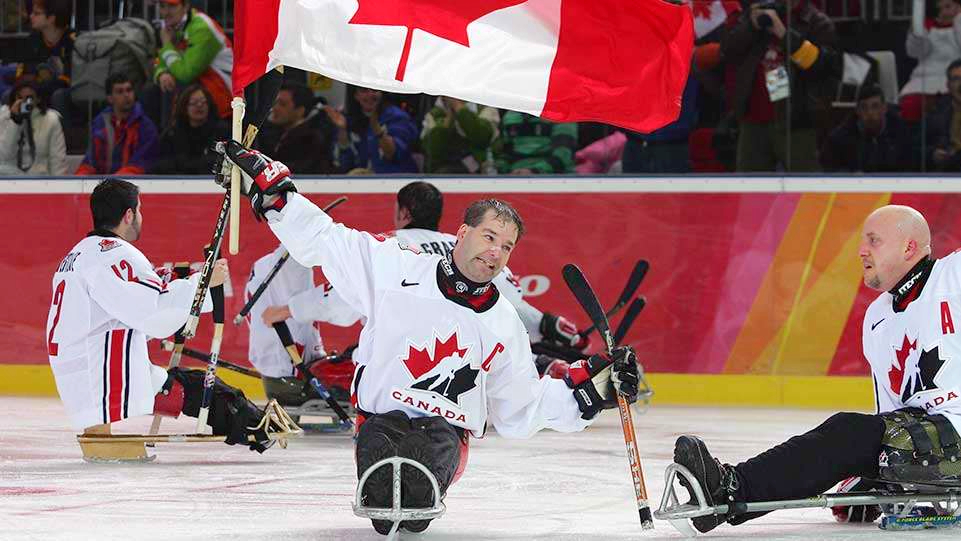
This edition looks back at the first Bell Canada Ottawa International Hockey Festival (now called the Bell Capital Inducted into Ottawa Sport Hall of Fame in 2014, Todd Nicholson competed for Canada in six parasports, most prominently in para ice hockey where he served as Team Canada captain for 13 of his 18 seasons. Nicholson competed at five consecutive Winter Paralympic Games from 1994-2010, winning a medal of each colour.
Through a dizzying number of volunteer roles, he’s helped shape the parasport landscape locally, nationally and internationally. On March 18, 2006, Nicholson won what remains Canada’s lone Paralympic sledge hockey title. On the 20th anniversary, we look back at that moment in this Ottawa Sport History Highlight feature.

The Torino 2006 Paralympic Winter Games produced the biggest prize of Todd Nicholson’s career, but there were very serious doubts whether the Team Canada captain would even make it there.
Nicholson was hospitalized in September before the Games with a large abscess near his hip that refused to heal. He was effectively bedridden for the next 3+ months, hooked up to an IV, a vac machine to drain fluids, and on antibiotics. Before the end of the year, the Kinburn athlete had had 13 surgeries, but still didn’t have the abscess fixed.
“I was very fortunate in the end. I found a doctor who said, ‘I can’t heal the wound, but I’ll maintain it so that you can still go to the Games and compete,’” Nicholson recalls.
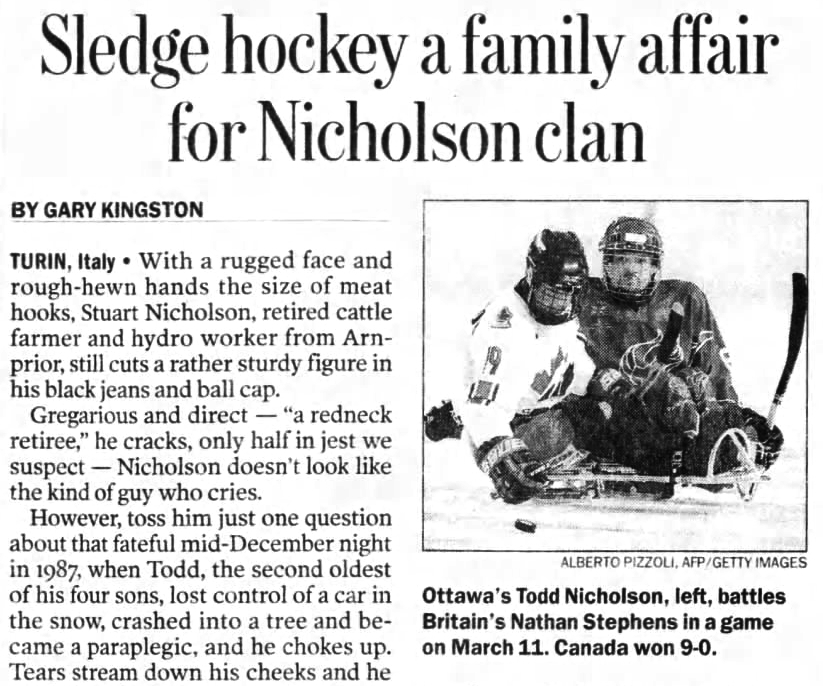
Nicholson got out of the hospital on Dec. 20 and come Dec. 27, he was in Vancouver for the World Junior Hockey Championships, where the national sledge hockey team put on a demo. He never missed a practice or a game from there.
“The team was amazing to help me get to where I needed to get to,” signals the member of the 1998 and 2002 Paralympic all-star team. “I was surrounded with the right people to help me get to the Games, and my family was there and pushed me to keep going.”
Nicholson’s medical team played a critical role. His wound was still a major worry and required a high level of attention. He kept a PICC line in his arm so he could get antibiotics four times a day, and the vac machine was essential out of fear that he could go into septic shock if fluids weren’t drained within three hours.
When Nicholson was on the ice, he had to keep the machine underneath his sled, which posed a problem when it got hit by a puck. The machine broke twice while he was in Sweden and Czech Republic in advance of the Games, but the team had contacts of doctors in each place he was travelling in case anything went wrong.
“Within two hours, I had another (machine) delivered. It was amazing,” says Nicholson, who played with a pump on his back during the Paralympics.
Nicholson scores flag bearer honour, with an assist from duct tape
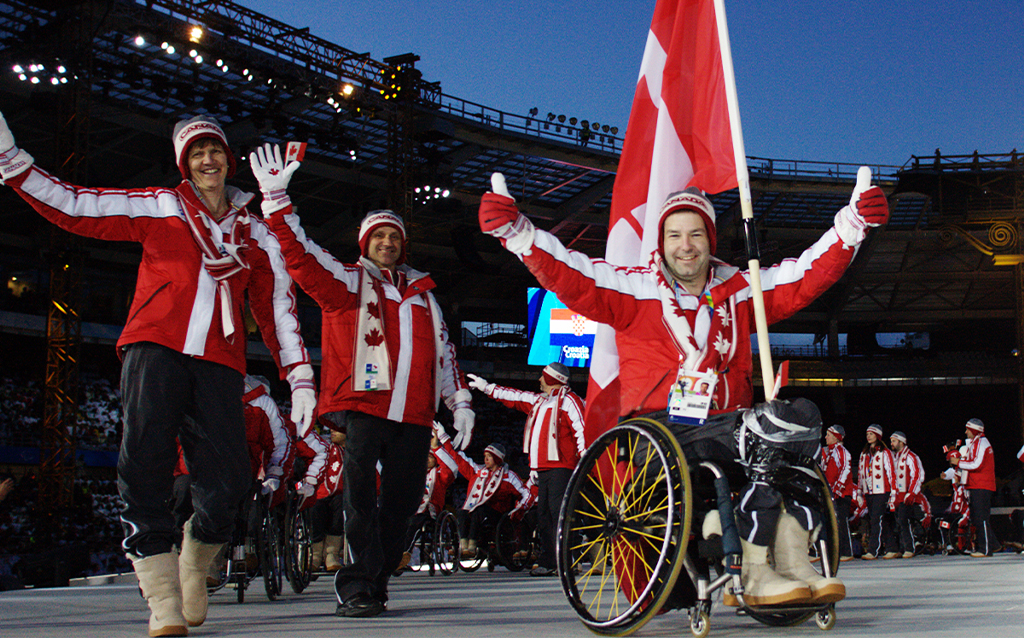
In the lead-up to the Games, Nicholson was chosen as Canada’s flag bearer for the Opening Ceremonies at the outdoor Stadio Olimpico Grande Torino.
“It was a great honour to be able to lead Team Canada, especially after everything that I had gone through to get there,” highlights Nicholson, who spoke to Canada’s 2006 Olympic flag bearer Danielle Goyette of the women’s hockey team beforehand.
“She said, ‘Todd, they’re going to tell you to hurry up. They’re going to tell you to slow down, tell you to do this, to do that,’ and then she said, ‘You know, you’re never going to get the opportunity to do this again, so do it at your pace, whatever it is you want to do, and just savour the moment.’”
Nicholson’s experience carrying the flag certainly proved to be an extraordinary memory, filled with about as much drama as an overtime hockey game.
It was all very exciting before the ceremony when organizers attached an apparatus to Nicholson’s wheelchair to hold the flag so that he could push with both hands.
“They hand me this flagpole outside of the staging area, and I put the flagpole in this apparatus, and I thought it’d be fun to do a 360 in my chair,” he recounts. “Sure enough, I go to do the 360, and this apparatus snaps.”
Nicholson’s assigned companion for the ceremony, a beautiful woman dressed up in full costume, was up in arms after the incident, speaking to him with great animation in Italian.
“I couldn’t understand what she was saying, but I was positive she wasn’t asking for my phone number,” quips Nicholson.
Fortunately, the Canadian para alpine ski team never travelled anywhere without a toolkit, including an always-versatile roll of duct tape.
“So we took the flagpole, we shoved it between my legs and into my boot, and then duct taped my legs together, and then duct taped me to the chair,” Nicholson details.
The team was very proud of their work, until it came time to enter the stadium. Suddenly an immovable 17-foot flagpole had to get through an eight-foot tall doorway.
“Son of a gun, what the heck are we gonna do here?” Nicholson continues. “Luckily again, we had some skiers with us with a brain in between their shoulders, so they lied me down to my back and wheeled me through the door, while making sure the flag doesn’t touch the ground.
“And what’s going through my head this whole time is Danielle Goyette telling me, ‘It’s an amazing experience. You’ll never forget it.’ She sure was right.”
Teamwork the key to underdog Canada’s triumph
Team Canada was not favoured for gold going into the 2006 Games. The Canadians had never won the Paralympics since hockey joined the programme in 1994. Norway were the defending world champions, and Canada hadn’t made the podium at the 2004 worlds.
Nicholson was slotted in as second-line centre alongside fellow Ottawa area player Marc Dorion and Peterborough’s Jeremy Booker, whose combined ages equalled the 12-year national team veteran’s at 37.
“All I had to do is I control the puck,” Nicholson recalls. “I’d set those boys up and then they’d run around like chickens with their heads cut off.”
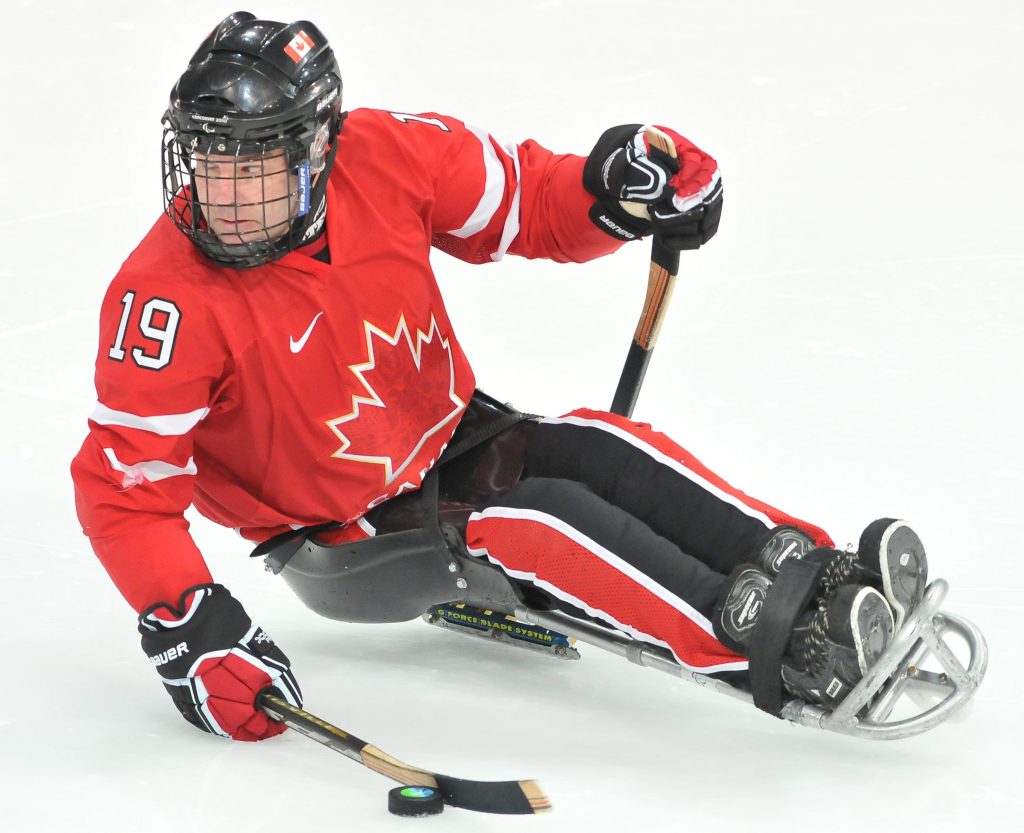
Canada had a couple easier opponents to start the tournament, handling the last Games qualifier Great Britain 9-0 in the opener.
In the second match, Canada had an early goal disallowed when Nicholson found himself not only in the crease, but actually in the net behind the goalie. He redeemed himself shortly after by scoring the opening and winning goal as Canada plowed past host Italy 11-0 on the second day of action.
He then added an assist in front of a packed crowd at the Torino Esposizioni, a convention centre transformed into a 4,000-seat venue for sledge hockey (which has since been renamed para ice hockey). The Canadians booked their place in the playoffs with their second win.
A much greater test came in Canada’s last preliminary round game. Nicholson was in the penalty box while Norway jumped ahead 3-0 before the third minute mark of the second period en route to a 4-1 Canadian loss, despite outshooting the Norwegians 16-12.
“They had some big boys. With their size, they were very intimidating and they played a physical game. And they had some of the best players in the world,” explains Nicholson, now grateful for his rivals’ role in setting the stage for the sport today, while lamenting that some powerhouse programs from 20 years ago like Norway and Sweden have since faded.
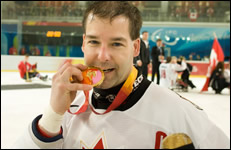
Canada drew a surprise opponent for the semi-final round as Germany managed to top the other pool thanks in large part to an upset win over USA.
“They were competitive games and you had to work for it and play systems and do what needed to be done in order to be successful, both on and off the ice,” indicates the 2000 and 2008 world champion.
Against Germany, Nicholson pushed the puck ahead on a faceoff and Booker scored Canada’s first goal, which turned out to be the game winner early in the second period. The Canadians cruised on to a 5-0 win and they made sure to enjoy the moment that guaranteed they’d win a medal, even as their rematch with Norway loomed large.
Nicholson had many sources of inspiration heading into the championship game. He’d received piles of get well cards from a local school while he was in hospital earlier. He got a call from Wayne Gretzky before the final. And he was given a wristband by the father of NHLer Dan Snyder, who died in a car crash, which was particularly meaningful since Nicholson had become paraplegic following a winter crash in 1987.
“Us players, we had a team meeting on our own before the game and said, ‘We’ve got very strong depth on this team, and if we all play our roles and commit to doing what we need to do, we can be successful,’” Nicholson notes. “The biggest thing for us in Torino was that we played together as a team.
“We had 15 guys there, and we played 15 guys. We had three distinct lines. We had a checking line, a scoring line, and a line that just went out there and tried to slow down some of the other teams. And we were successful right through to the finish of the Games.”
That message of team unity continued to be communicated on the bench and on the ice throughout the gold medal final. Everyone was supporting one another.
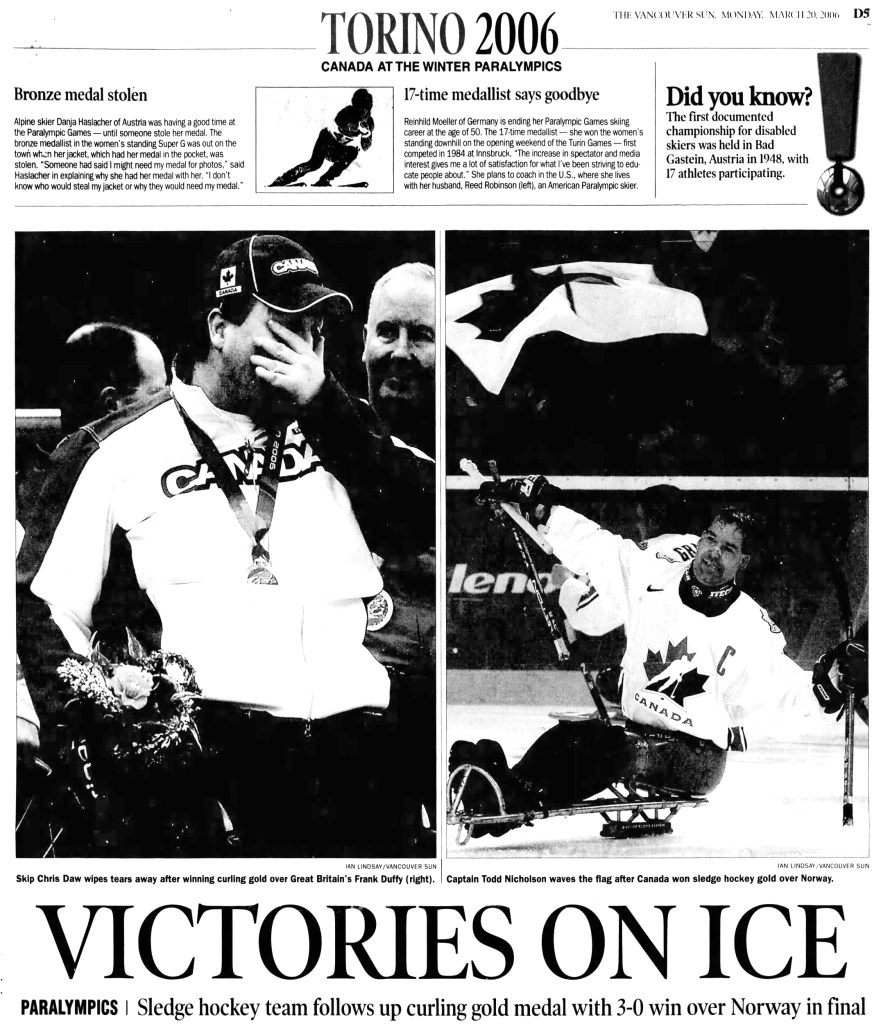
Brad Bowden set the tone for Canada with a goal less than three minutes in. Just before the end of the second period, Nicholson was on the ice for a powerplay goal by Greg Westlake, the lone member of the 2006 team who returned to play for Canada in Italy at the Milano Cortina 2026 Paralympics.
Canada was outshot by Norway 10-2 in the third period and 18-9 overall, but goaltender Paul Rosen held the fort for the shutout and Billy Bridges clinched the gold with an empty-netter for his third point of the game in the 3-0 triumph.
“When that final whistle blew, and flags are being thrown onto the ice for us, just being able to witness that, and we had an amazing crowd there as well, a lot of family and friends made the trip over, it was so special to share that with them,” underlines Nicholson, who was joined by his father Stuart Nicholson, his mother Carol and his brothers Kevin, Jason and Gordie (who managed to sneak his way into the Canadian dressing room to join the post-game revelry). The crew had previously driven 52 hours in the family Winnebago to watch Nicholson at the Salt Lake City 2002 Games.
“Looking back to December of that year, I didn’t think I’d be at the Games,” Nicholson notes. “I’m glad I pushed myself through and people pushed me to get to the Games because it’s the only gold Canada has ever won.”
Legacy lives on well after golden Games
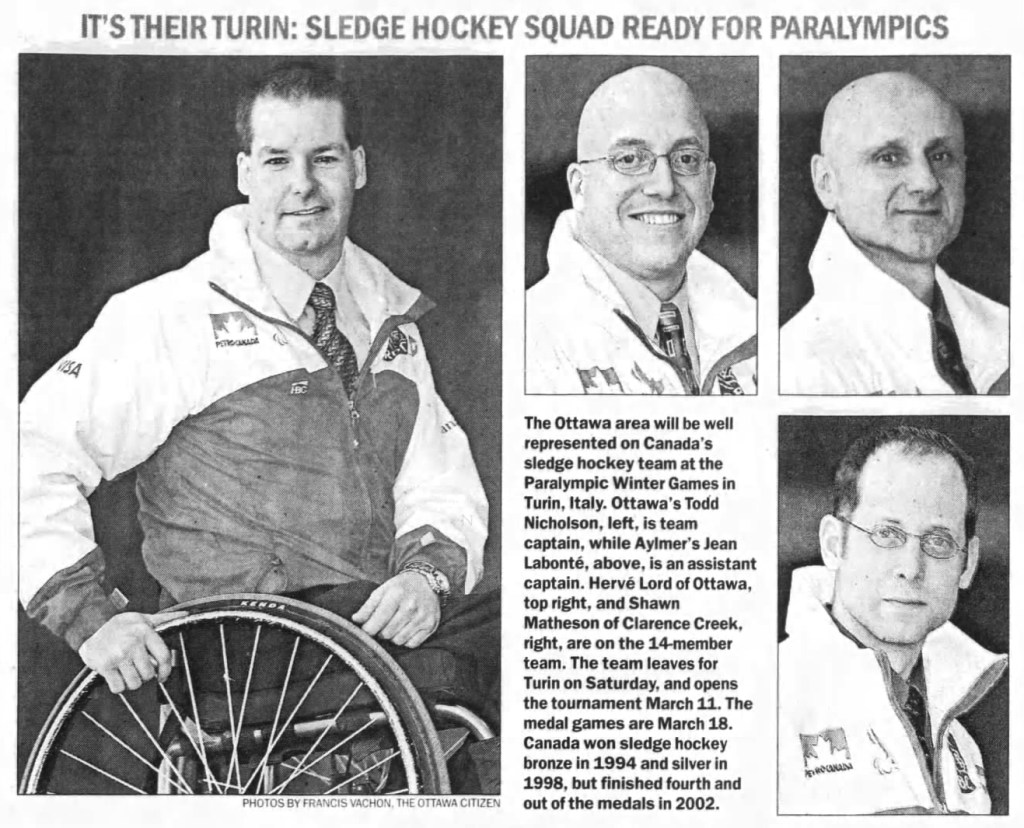
Nicholson was among seven Ottawa-based players welcomed home on a Greyhound bus at the former Catherine Street station. The others included the youngest member of the team Dorion (age 18), the eldest in Hervé Lord (age 48), Jean Labonté, Graeme Murray, Ray Grassi and Sean Matheson.
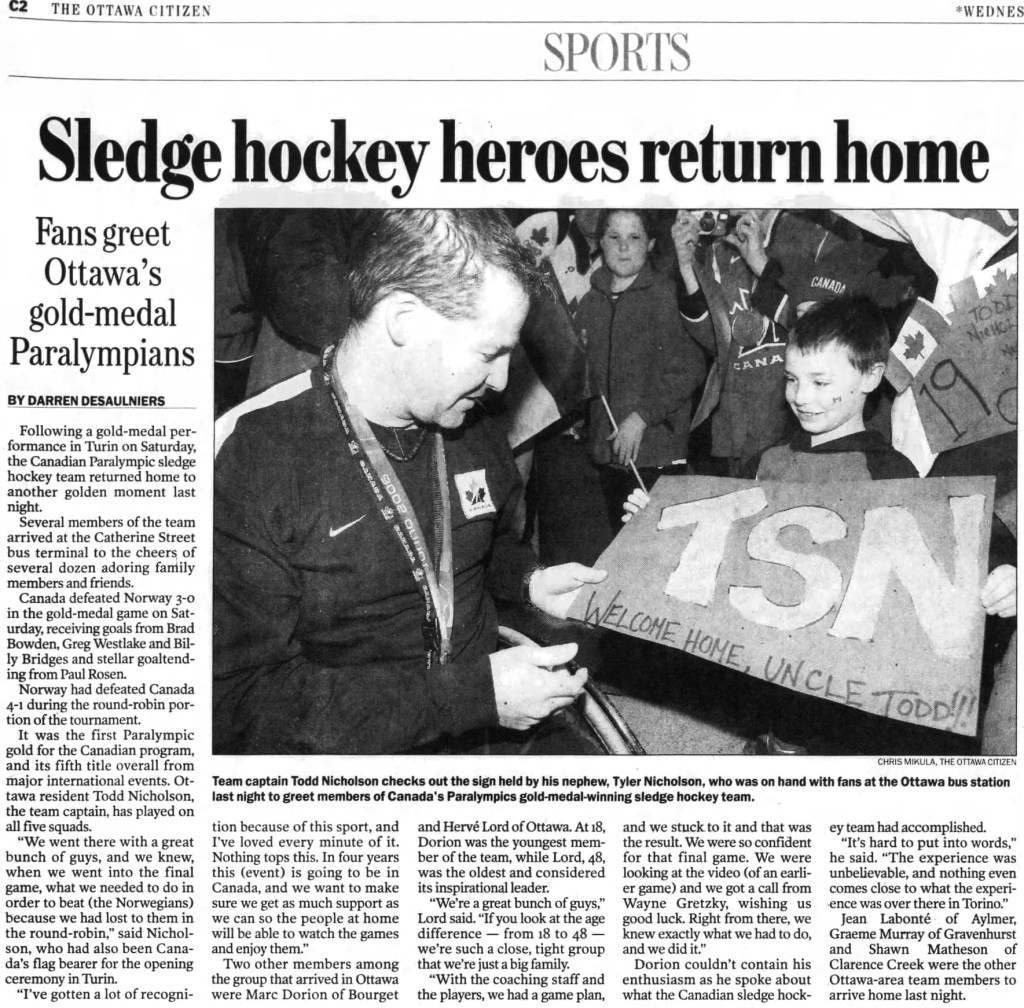
In advance of the Paralympics, the City of Ottawa donated ice time three times a week so the group of seven Team Canada athletes could practice together alongside several more quality local players.
“It was probably key for us, especially leading up to the Games,” says Nicholson, noting they arrived in shape with a great team connection already established. “That helped us get to the final stage and pushed us to get there.”
Shortly after returning home, Nicholson’s next stop was a visit with Dr. Gary Sibbald, a dermatologist and wound care specialist in Toronto.
“He told me he would only commit to doing the surgery (to properly fix the wound) if I committed to retiring. So I told him exactly what he wanted to hear and I said I would retire,” smiles Nicholson. “I just didn’t tell him when.”
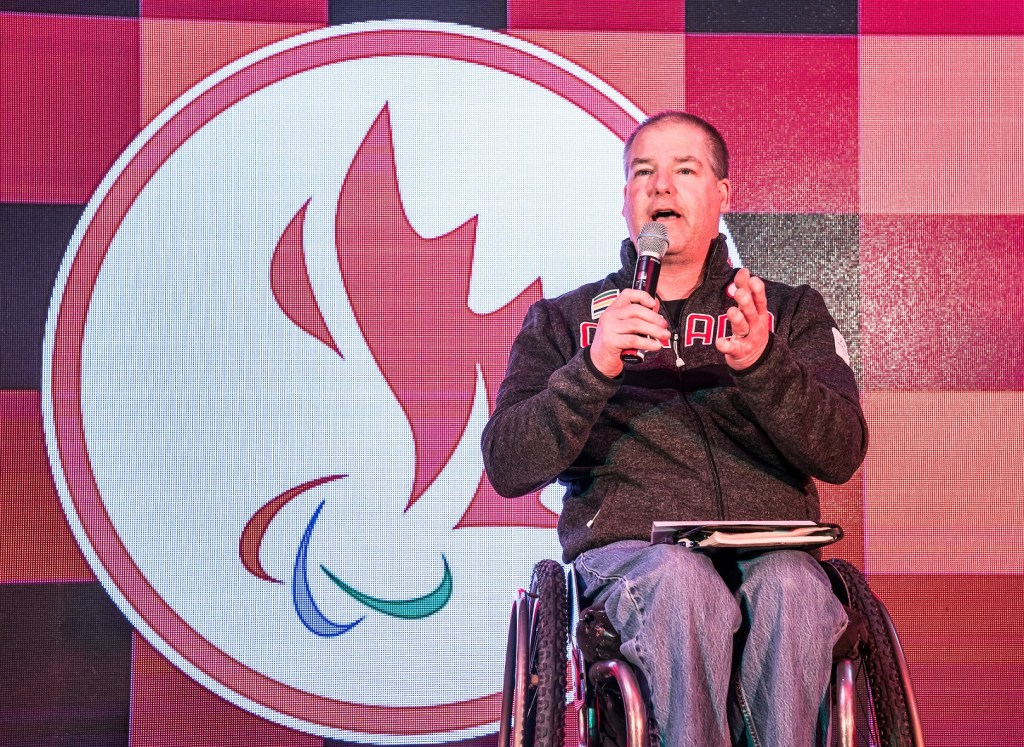
With the Vancouver 2010 Games on the horizon, Nicholson knew he most definitely wanted to play in one more Games on home ice. After nine weeks of bedrest and seven months away from training, Nicholson returned and ultimately made that objective a reality.
Part of the dream was also to compete for Team Canada at the 2010 Paralympics with his partner Emily Glossop, who was a guide skier for a para alpine athlete with a visual impairment, but after she was injured, they shifted their focus to building a family and welcomed twins less than a year before the Games.
After placing fourth at Vancouver 2010, Nicholson jumped into many administrative roles in sport. He served on the International Paralympic Committee’s Athletes Council, he became chair of Own The Podium, and was chef de mission at PyeongChang 2018 when Team Canada won its most medals ever at a Winter Paralympics with 28 medals.
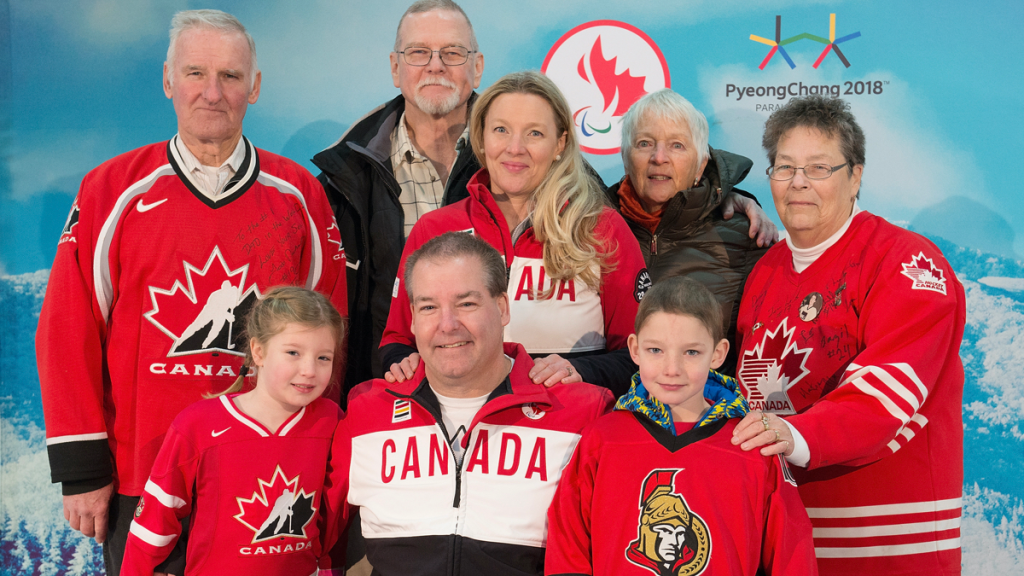
Nicholson remains a board member for Abilities Ottawa, an organization run by Glossop that promotes and provides inclusive and parasport opportunities in the capital. In 2023, the Dunrobin couple were jointly presented with the Ottawa Sports Awards’ Mayor’s Cup for Outstanding Contribution to Sport in Ottawa.
Nicholson’s 2006 gold medal continues to frequently appear at Abilities Ottawa events.
“My medals don’t sit behind glass or in a safe or anything like that. They’re for people to see,” highlights the Class of 2025 Canadian Paralympic Hall of Famer. “It’s a great thing to be able to take around to schools and show kids and hopefully encourage them to follow through on their dreams.”
 Ottawa Sport Hall of Fame
Leave a comment