

Ottawa has a long and proud sport tradition, and in this ongoing series, we present highlight moments and figures from our local sport history. The Ottawa Sport History Highlight series is produced collaboratively by the Ottawa Sports Pages and the Ottawa Sport Hall of Fame, which has welcomed almost 300 inductees dating back to its establishment in 1968.
In this edition of the Ottawa Sport History Highlight Series, we look back on many moments of little-known local basketball history.

The next time you pull up to Parliament Station on the O-Train’s Confederation Line, take a moment to appreciate the fact that you’ve just passed under the site of a significant piece of national history.
And no, it doesn’t have the type of political connection you might expect. You’ve actually reached the place where the first game of basketball was played on Canadian soil.
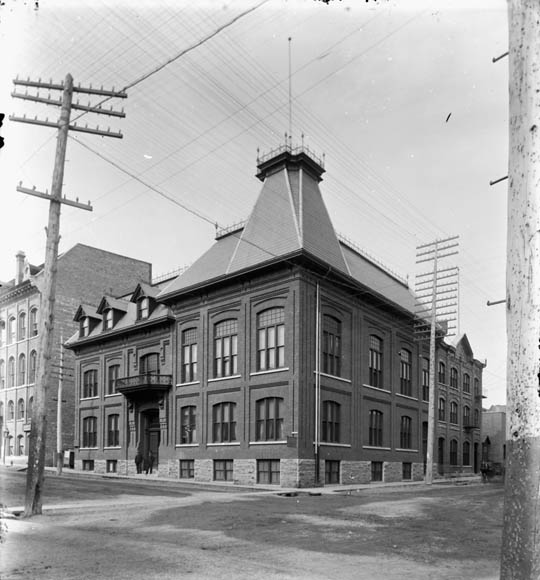
Now, you probably never would have had any idea about that key moment when you walk out of the station in the shadow of Parliament. And that reality is a big part of what inspired Leo Doyle to create the new Walking Tour of Ottawa Basketball History and Heritage.
“We have all these really compelling stories about basketball, and local basketball, that we just didn’t know about,” explains Doyle, who has recently uncovered many forgotten tales in Ottawa’s sports history.
“People’s knee-jerk reaction is, ‘well, you know, Ottawa’s a hockey town…’ But have you ever heard of Dave Smart? That ought to be another source of pride for our city and something we celebrate as well,” he adds. “Yes, hockey is a big sport here, but basketball is deeply-rooted too.”
Doyle’s 12-stop tour of downtown Ottawa is filled with countless neat nuggets of local basketball lore. Here are a few examples:
• Rideau Canoe Club paddlers have picked up piles of Canadian championships on water over the years, but within their history is also a national basketball title. The Ottawa Rideau Aquatic Club won the first-ever hoops national championship final 38-36 over the University of British Colombia in a two-game total-points series played in front of 5,000 fans in Vancouver. (It was the second edition of the sanctioned nationals tournament, but Toronto forfeited the final a year earlier.) Two-time Ottawa Rough Rider Grey Cup champ Don Young, a cousin of basketball inventor Dr. James Naismith, was part of that champion team in 1924-25.

• Young and Naismith are two of several basketball pioneers inducted into the Ottawa Sport Hall of Fame, along with Team Canada coaching legend Jack Donohue, multi-sport star and inaugural Ottawa Jewish Sports Hall of Fame inductee Jess Abelson, and dynastic Carleton University Ravens coach Dave Smart. Naismith grew up in modern-day Almonte, but had a lot of family in Ottawa. Doyle’s tour begins on Sparks Street and highlights several nearby businesses and residences of Naismith’s extended family.
• Naismith made one of his final public appearances when he spoke at the Ottawa YMCA in April 1939 just a few months before he died of a brain hemorrhage. His visit was spurred by Thomas Duncan Patton, who was the captain of one team during the first-ever basketball game played, in 1891, under Naismith’s watch in Springfield, Massachusetts. Patton had earlier helped organize the first basketball game in Canada at the original Ottawa Y on the northeast corner of Queen and O’Connor streets.
• Patton spearheaded the construction of a new Ottawa YMCA building in 1909 at Laurier and Metcalfe, which is now the site of a boutique hotel across the street from the Ottawa Public Library’s main branch. That was the site of a key meeting in 1942 that led to the founding of Carleton University, which has become known for its basketball dominance, although it wasn’t always that way. When the university’s first athletics director Norm Fenn took a look at Carleton’s basketball players, he couldn’t believe how poorly skilled they were. They’d always take two-handed set shots, so Fenn brought out Glen Pettinger and Bob Simpson – who was also a Rough Rider and future city councillor – to show them how modern basketball players shoot.
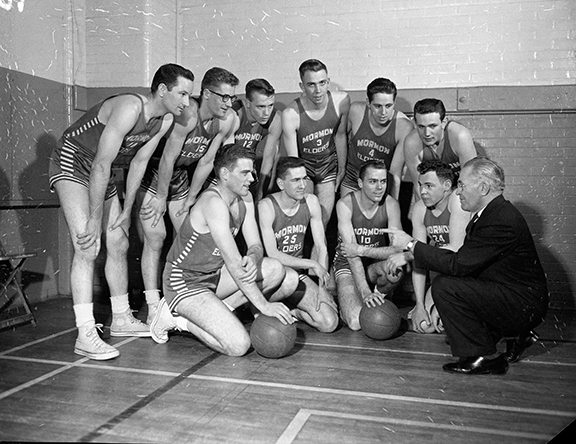
• Pettinger and Simpson were members of the Canadian Olympic basketball team for the 1952 Summer Games in Helsinki, Finland. Parliament Hill had a role in making their Olympic trip happen (and no tour of Ottawa’s downtown would be complete without a stop there, of course). An early game played on Parliament Hill was between a local Mormon basketball team and the Tillsonburg Livingstons, who were Canada’s representatives at Helsinki 1952, but the southern Ontario squad picked up a couple of talented Ottawa players (Pettinger and Simpson) on their way.
“The story of basketball is just this fascinating evolution of the sport and people in Ottawa,” Doyle highlights. “I’ve really been astounded by what I’ve come up with in my research, and I definitely wanted to share those stories, so I thought the tour would be one way I can do it.”
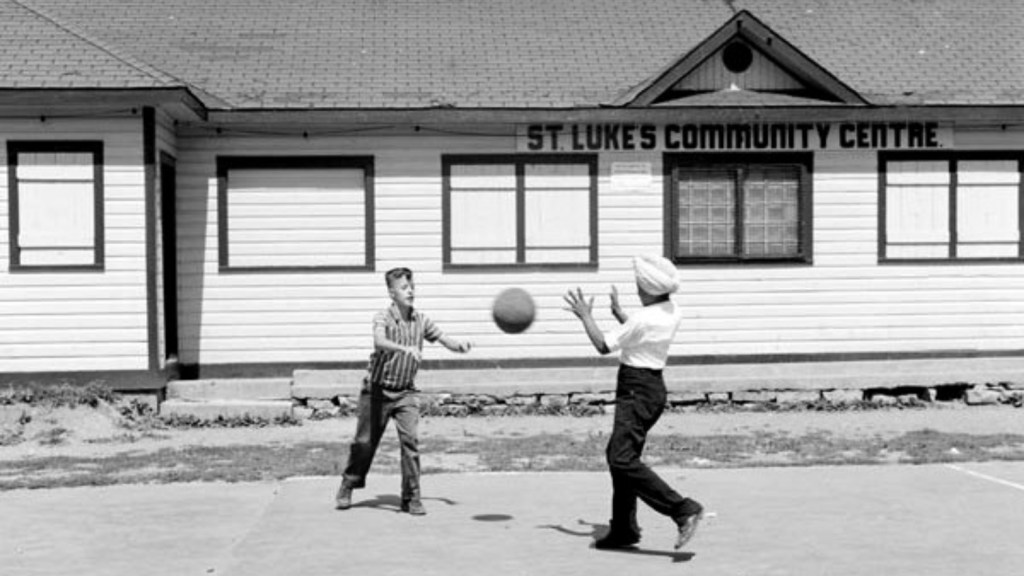
The last stop on the tour is St. Luke’s Park, which Doyle says is Ottawa’s version of the fabled Rucker Park in Harlem, New York, serving as an important meeting place for people of different origins.

The basketball court at St. Luke’s, now being renovated, has served that purpose for over 80 years. It’s where many newcomers to Ottawa have made social connections and built community. Paris 2024 Olympian Marial Shayok, who has South Sudanese roots, was one of many stars who’s played there.
But beyond high-performance street hoops, there are many more integration stories stemming from St. Luke’s. Doyle shares the connection the sport fostered between Rupinder “Bobby” Singh Kauser and Doug Currie in the late 1950s. Singh Kauser’s father worked for India’s High Commission and often got picked on, but Currie became friends with him by playing basketball together at the park near Elgin and Gladstone.

“That is a massive conversation within the Ottawa basketball scene – that belonging, solidarity and togetherness is one of the biggest pieces of the sport,” signals Doyle, also founder of the Ottawa Basketball Network. “Sport is like medicine. Sport is a way to build community and pull people together.
“It’s different than talking politics or other stuff that can be divisive. It’s that thing that we love and we share and that brings us together. And if we recognize that, and we recognize one another, then the things that we don’t share in common become easier to reconcile.”

Doyle would love to see basketball recognized more prominently in Ottawa. He believes the city should have plaques commemorating historic moments and influential individuals for basketball, in a similar vein to the Stanley Cup monument on Sparks Street.
And there is an opportunity for a legacy project, which could include refurbishing gyms and making them more accessible, in 2026. That will be 200 years after Bytown was established and it’s also when Ottawa will welcome the Wheelchair Basketball World Championships, which will showcase another aspect of the sport’s inclusivity.
“Storytelling allows us to how understand how we got here,” Doyle notes. “When you understand, it can possibly help create a better future.”

 Ottawa Sport Hall of Fame
Leave a comment